


No products in the cart.
6 Rules for a Perfectly Tailored Suit
"Six fit rules our master tailors check in every fitting: shoulders, collar, jacket length, sleeves, waist and trouser break. Here is how to recognise a perfectly tailored suit."
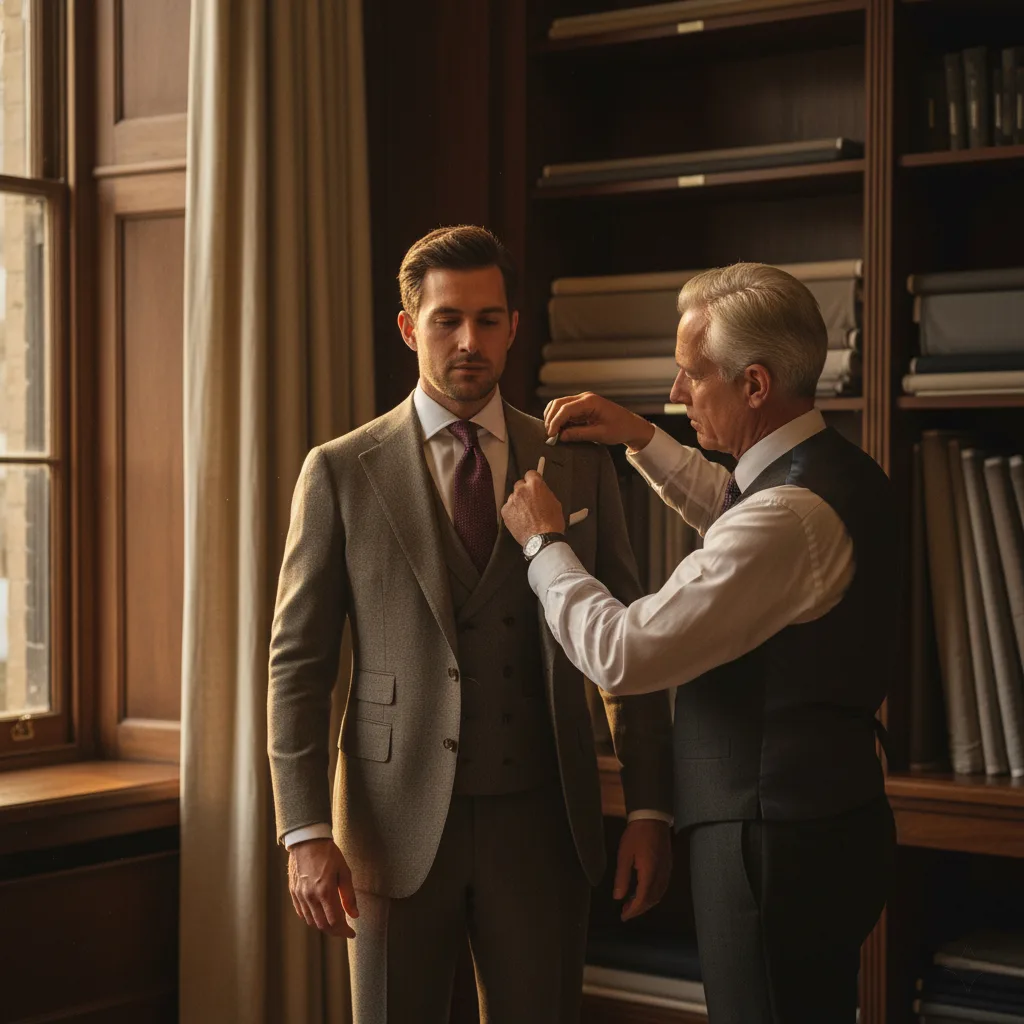
A well-fitted suit changes how you stand, how you move and how others read you within the first few seconds. A poorly fitted one does the opposite, no matter how fine the cloth or how famous the label. After more than seven decades of cutting suits for gentlemen in Jakarta, our master tailors have learned that a perfectly tailored suit almost always comes down to the same six details.
Whether you are refining a ready-to-wear suit or commissioning a bespoke suit from scratch, these are the rules we check first in every fitting room.
1. Start With the Shoulders
The shoulders are the foundation of the jacket. Everything below them, from the chest to the hem, hangs from that line. The shoulder seam should end exactly where your own shoulder ends: no overhang, no dimple at the top of the sleeve, no tightness when you reach forward.
This is also the most difficult area to change after a jacket has been made. Rebuilding a shoulder means taking apart the sleeve, the canvas and the padding, and the result is rarely as clean as the original. Our advice is simple: if the shoulders of a ready-made jacket do not fit, keep looking. In a bespoke suit, the shoulder is drafted from your own posture, which is why it sits naturally from the first fitting.
2. The Collar Should Hug, Not Hover
Turn sideways in front of a mirror. The collar of the jacket should rest lightly against your shirt collar all the way around the neck. If there is a visible gap at the back, or the collar rolls away from the shirt when you stand straight, the balance of the jacket is wrong for your posture.
Small collar gaps can sometimes be corrected by a skilled tailor. Larger ones usually point to a deeper mismatch between the pattern and your body, for example a forward neck or one shoulder sitting lower than the other. These are exactly the details our cutters record in your personal bespoke pattern, so they are solved before the cloth is cut.
3. Get the Jacket Length and Button Point Right
A jacket that is too long shortens the legs; one that is too short makes the whole silhouette look borrowed. As a guide, the hem should cover the seat of your trousers and fall around the point where your thumb knuckle rests when your arms hang loosely.
Just as important is the button point. On a two-button jacket, the top button should sit at or slightly above your natural waist. Set it right and the jacket draws a clean V that makes the shoulders look broader and the waist slimmer. Set it too low and the jacket looks heavy; too high and it looks tight. Jacket length and button position are almost impossible to change later, which makes them a key reason many gentlemen move from ready-to-wear to bespoke.
4. Show a Little Shirt Cuff
With your arms relaxed at your sides, around 1 to 1.5 centimetres of shirt cuff should be visible below the jacket sleeve. That small band of white or pale blue frames the hand, protects the jacket sleeve from wear, and signals that the suit was made with care.
On ready-made jackets with decorative buttons, shortening the sleeve is straightforward. Jackets with working cuff buttons, often called surgeon’s cuffs, must be shortened from the shoulder instead, which takes more time and skill. In a bespoke jacket, sleeve length is measured for each arm separately, because very few people have two arms of exactly the same length.
5. Shape the Waist Without Restricting Movement
Many ready-made jackets are cut generously through the middle to fit as many body types as possible. The result is a boxy shape that hides your build rather than flattering it. Taking in the waist restores the natural line from chest to hip.
The goal is shape, not tightness. With the jacket buttoned, the fabric should lie smoothly across the front with no X-shaped pulling around the button. You should be able to sit, drive and lift your arms comfortably. In Jakarta’s heat, a jacket that is slightly too tight also feels much warmer, so we always balance a clean silhouette with room to breathe. If you are choosing cloth for our climate, our tropical suit fabric guide explains which weights and weaves keep a suit cool.
6. Finish With the Trouser Break and Taper
The break is the small fold where the trouser hem meets the shoe. For a modern, clean look, choose a slight break, where the hem just touches the top of the shoe, or no break at all for slimmer cuts. Excess length pooling around the ankle is the single most common fault we see, and the easiest to fix.
Above the hem, a gentle taper from knee to ankle keeps the leg looking long and in proportion with a fitted jacket. Avoid going so narrow that the trousers cling when you sit. The trouser should fall in one clean line from hip to shoe when you stand.
Ready-to-Wear Adjustments or a Bespoke Suit?
Rules 4, 5 and 6 can usually be achieved by altering a good ready-made suit. Rules 1, 2 and 3 depend on the original cut, and that is where bespoke tailoring makes the real difference. A bespoke suit is drafted from your own measurements and posture, then refined over at least two fittings, so every rule on this list is built in from the start rather than corrected afterwards.
For grooms, the same principles apply with even higher stakes: every photograph will show how your suit fits. Our wedding suit service in Jakarta follows these six rules through a staged fitting schedule timed to your wedding date.
If you would like a master tailor to check your fit, or to begin a suit made entirely around you, book an appointment at any of our ateliers or learn more about our bespoke tailor service in Jakarta.
Frequently Asked Questions
What is the most important part of a suit’s fit?
The shoulders. They carry the whole jacket and are the hardest part to alter afterwards. If the shoulder seam sits exactly where your own shoulder ends, almost everything else can be refined.
How much shirt cuff should show below a suit jacket sleeve?
Around 1 to 1.5 centimetres of shirt cuff should show when your arms rest naturally at your sides. It frames the hand and keeps the proportions of the suit balanced.
Can an off-the-rack suit be tailored to fit perfectly?
Trouser length, sleeve length and waist can usually be adjusted well. Shoulders, collar balance and jacket length are far harder to correct. If those three are wrong, a bespoke suit cut from your own pattern is the better investment.
How long does a bespoke suit take at Laxmi Tailors?
A bespoke suit usually takes several weeks from measurement to collection, with at least two fittings in between. For weddings and events, we recommend starting two to three months ahead.
Ready for a Fitting?
Visit any Laxmi Tailors atelier for complimentary advice, or schedule a private consultation.
Book Appointment →