


No products in the cart.
Inside the Cutter’s Notebook: How Your Pattern Becomes a Lifetime Asset
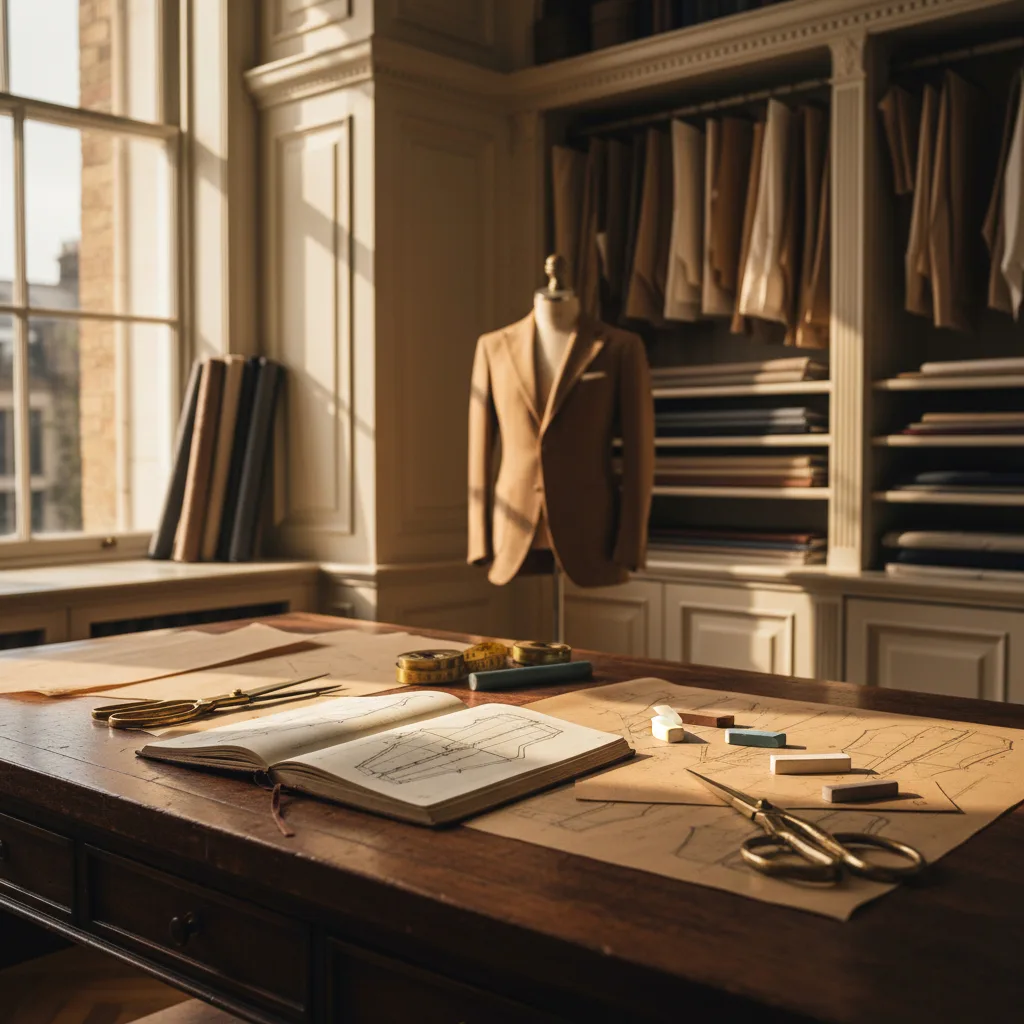
“From the first tape measure to the last chalk mark, how a bespoke pattern is drafted, refined, and quietly updated to follow you through every chapter of life.”
Step into any great tailoring house and you’ll find the same quiet constant: a shelf of worn folders and pattern papers, each one marked with a name and a date. They are more than files. They are a private archive of lives well dressed. When we say your suit is “cut to your pattern”, we mean that quite literally. A cutter drafts a unique blueprint of your body—your posture, balance, and the way you naturally stand when no one is watching.
1. Reading the way you stand
A fitting doesn’t begin with the tape measure. It begins with observation. Before a single measurement is taken, your cutter watches how you walk into the room. Do you carry your weight slightly on one leg? Are your shoulders perfectly level? These nuances matter more than the number on a label. The cutter’s first responsibility is to read your stance and decide how the cloth should fall to flatter it.
2. Drafting the first pattern
Only after this quiet assessment does the tape measure come out. We note the usual figures—chest, waist, seat—but we also record subtle details: half-shoulder balances, front and back lengths, the pitch of your sleeve. On brown craft paper, the cutter then drafts your pattern. From this moment on, you are no longer a size—you are a pattern.
3. The fitting: where theory meets reality
The first suit from a new pattern is effectively a live test. At your basted fitting—where the garment is loosely assembled with white stitches—the cutter studies how the cloth behaves. A little excess drape at the blade, a diagonal line across the chest; these are the signals that guide the next round of chalk marks. Every alteration is transferred back to the paper pattern, ensuring your next commission begins already refined.
4. A pattern that grows with you
Life doesn’t stand still, and neither should your pattern. As years pass, you may change role, city, or routine. At each new commission, the cutter can gently adjust your pattern to reflect where you are now—without losing the underlying balance that makes your suits feel “like you”. Put on a jacket cut from a well-maintained pattern and you’ll notice a rare sensation: familiarity.
The Quiet Luxury of Continuity
“In a world of seasonal trends, the idea of a pattern that follows you for a decade is a quiet kind of luxury. You aren’t starting from zero. You are building on a foundation already shaped to your posture.”
5. Beginning your own pattern
Once drafted, refined and proven, your pattern becomes the reference point for every jacket, trouser and waistcoat we cut for you—whether in wool, linen, cotton or batik. Over time, the pages in your file fill with notes: events worn, cloths chosen, small refinements made. It is, in its own way, a journal of your life in tailoring.
Ready for a Fitting?
Visit any Laxmi Tailors atelier for complimentary advice, or schedule a private consultation.
Book Appointment →